Project Page Contents:
1. Introduction & Early Test Flights
2. Second Stage Development & Flights
3. 2008 Model Overview
4. 2008 Model Construction
5. NARAM-50 Flight
6. Future Modifications
This page contains photos and descriptions of various noteworthy model components, subassemblies and related items, as well as several views of the completed model at the bottom of the page (to skip to the model gallery, click here).
Tail Section/Motor Mount & Stuffer Tube Assembly
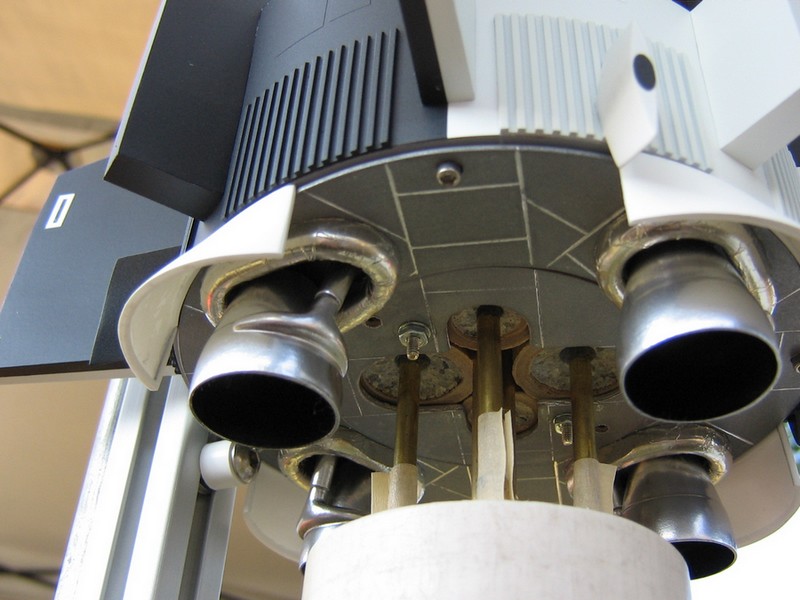
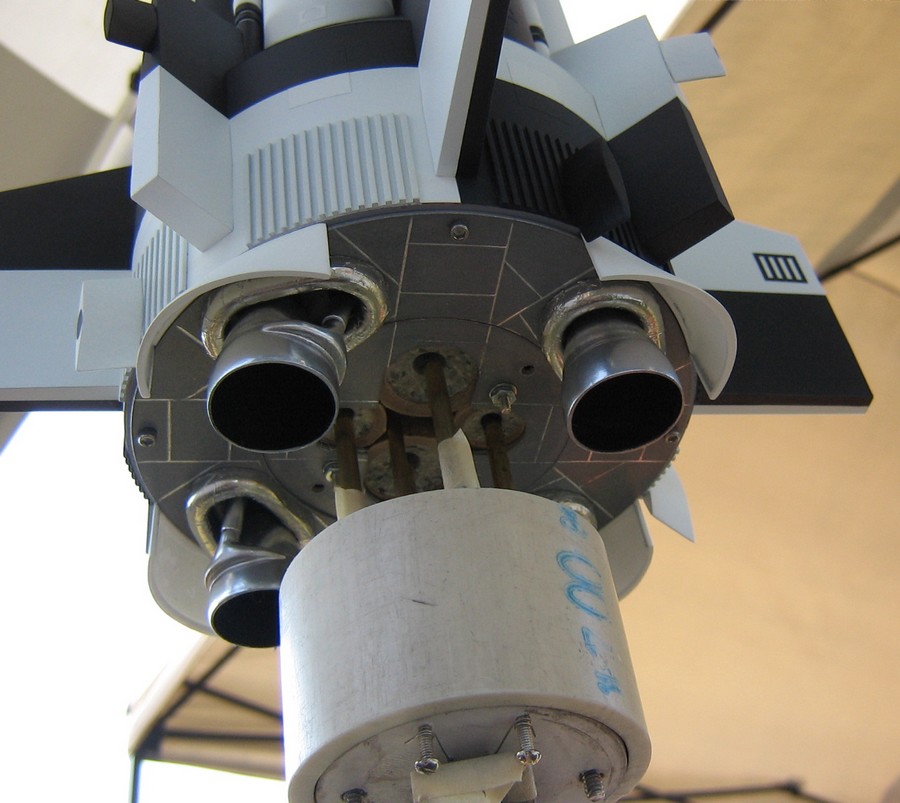
The tail section consists of three subassemblies that slide together. The scale base (A) has a split and reduced BT-80 that slides up inside the main shell (B). They are fastened together by four external #2 socket head cap screws that also serve as scale details. The motor mount/stuffer tube (C) form a single subassembly that is glued together permanently so as to maintain consistent alignment (critical for proper fit of the tank tubes).
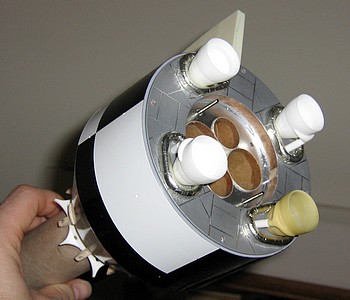
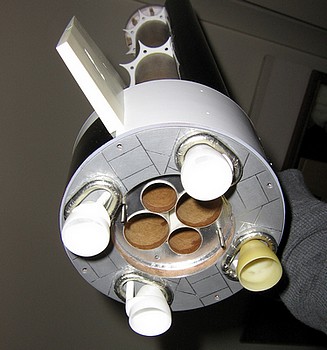
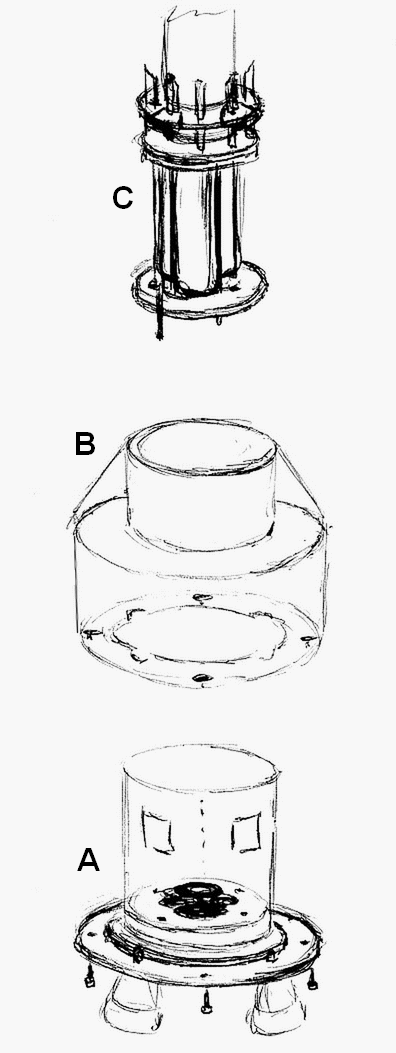
Prior to construction of part A, the motor mount/stuffer subassembly is aligned and glued together with the aid of a jig consisting of a long section of BT-80 with four “windows” cut near one end. The split BT-80 sleeve from part A is also used inside one end of the jig (see windows drawn in righthand sketch). The windows allow visual alignment of the stuffer tube and motor mount, and provide access for applying glue in small amounts.
Casting Hollow Fins
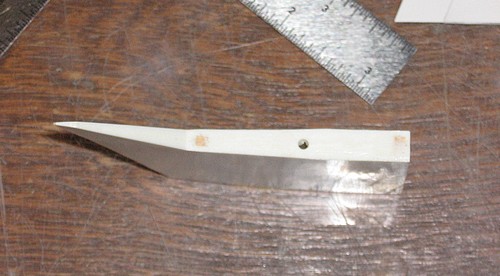

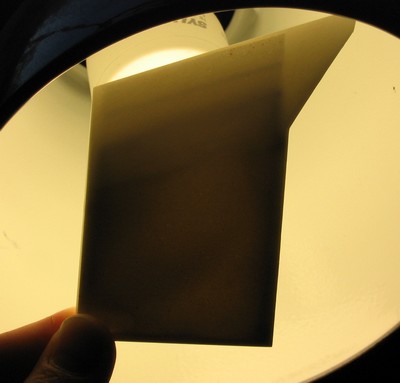
After each hollow casting was firm enough to handle (not completely cool), I had to drill a vent hole into the hollow space through the root edge. This prevented the fin from becoming bloated on the sides. I’m not quite sure why this is happens, but I have a pretty good guess… when a hollow casting is made, the resin gets hot (fast-curing Polytek Easyflo 60), while the air inside the hollow wedge stays relatively cool. As the casting cools, it contracts around the already cool air which presses outward on the not-yet-hardened sides of the fin… so that’s my hypothesis.
This technique yielded variable results for me and is worth some further experimentation. I also attempted to make the stub fins hollow using the same technique, but for whatever reason, I did not have very much success.
Fin Attachment

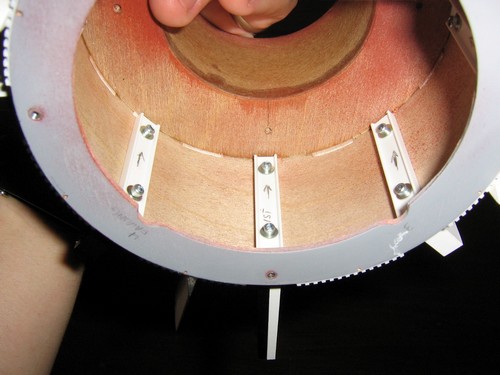
The polyurethane resin fins were each attached through the plywood wall using #2 self-tapping screws and washers (the hollow fins have a 1/8″ thick root edge that the screw threads can ‘bite’ into). Styrene I-beams were used between the plywood skin and screw heads as a means to conform the round plywood skin to the flat root edges of the fins, eliminating small gaps and providing a firmer anchor than the plywood skin alone.
A Few Interesting Tail Section Details…
Corrugation Troubles and an Odd Solution

Ideally I would simply construct a new master and recast all of them (this time pre-curling the pieces before they completely hardened). But I came up with an odd solution that yielded acceptable results in the time remaining. The resulting part consisted of four layers of material (from top down):
Styrene Strips (corrugations)
Trim Monokote (facing up)
Scotch 463 Double-Sided Tape
Trim Monokote (facing down)
The top layer of Monokote holds the corrugations on. While installing the strips, I was able to keep the unused portions of Monokote unexposed by covering with a loose piece of backing material and shifting it over as I progressed. After installing all the strips (not yet cut to final length), I brush-painted a coat of Future Floor Finish over the entire piece to de-sticky the sticky backing. After shaping and priming, the pieces were each applied to the model with the aid of soapy water, then painted in place on the model.
Heat Shield Panel Lines
The heat shield panel lines are simulated by scoring the surface of the plate (plywood with a layer of CA-soaked paper) to make slight recesses. The part is then primed, sanded smooth, then coated in Duplicolor Chrome. The entire surface is wet sanded with very fine sandpaper, changing the panels to a dull metalic gray and leaving the recesses shiny chrome.
Engine Nozzles (outboard positions only)
The simulated engine bells were roto-casted by hand in a simple one-piece mold.
Engine Skirts (fairings below Stub Fins)
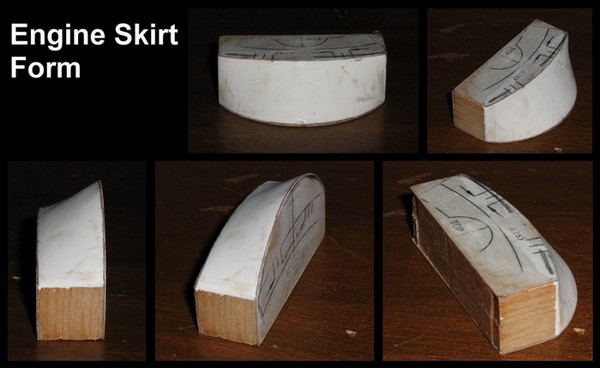
The master pattern/form was made from spruce strips, 1/64″ plywood, and Sculpey polymer clay. It was originally intended as a master pattern for making a rubber mold for some sort of a fiberglass (or resin) casting. The sculpted clay proved more difficult to get a perfectly smooth finish than I had anticipated, so I experimented with heat-forming styrene and found a technique that worked pretty well. Notice the extra markings on the printed paper parts of the pattern. These were planned locations of air scoop details that I did not have time to implement.
Tank Tube Design
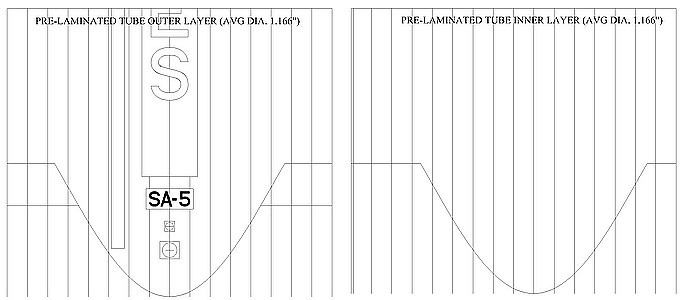
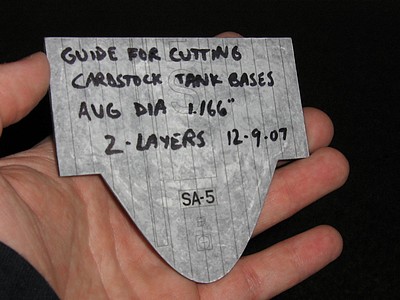
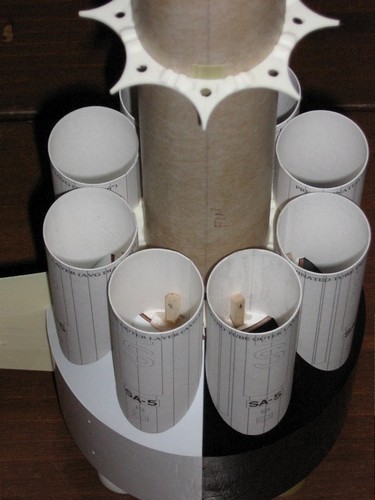
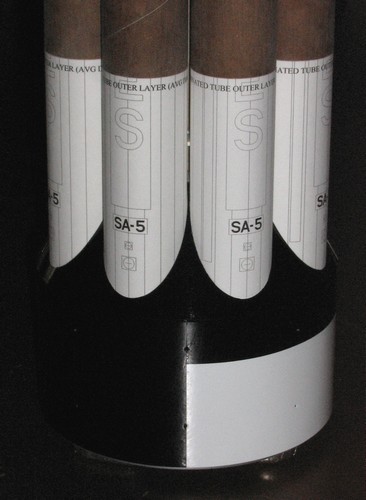
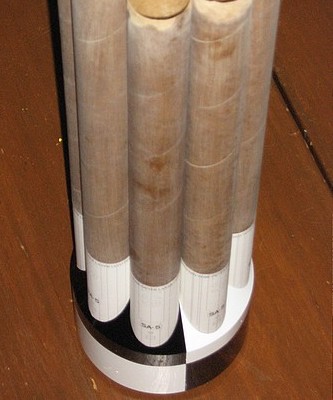
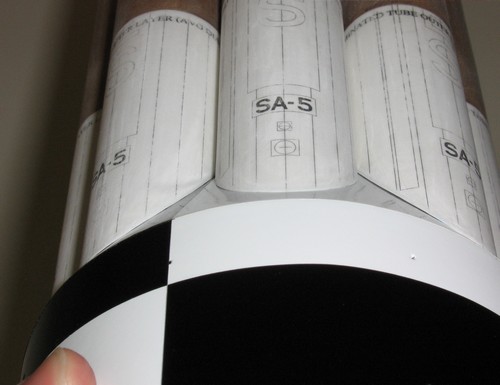
After some mixed results with my first fiberglass template, I devised a plan to make the mitered tank bases from two layers of cardstock with the inside layer offset slightly upward (to give the tank a nice sharp single-layer edge). Note that the average of the diameters [(O.D. + I.D.)/2] was used to account for the thickness of material. The two layers would first be glued together flat, then curled and joined. The completed cardstock section would then be coupled to the main paper tube. See photos below for more details. Note also the slight imperfect gap under the tanks in the lower right photo…once the fins are in place this view of the gap is masked. Also, the normal viewing angle is such that imperfections are generally hidden from view.
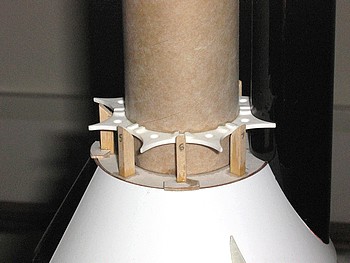
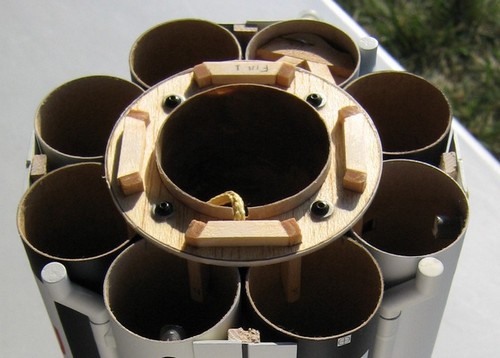
Tank Tube Mounting System
Interstage
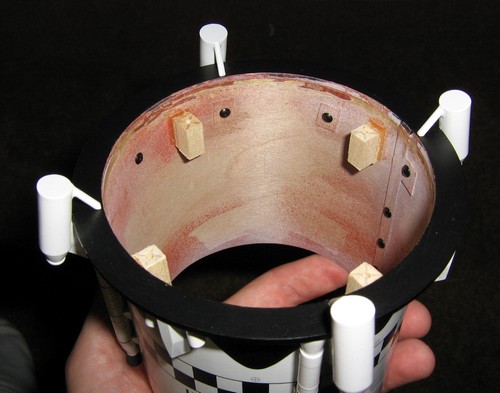
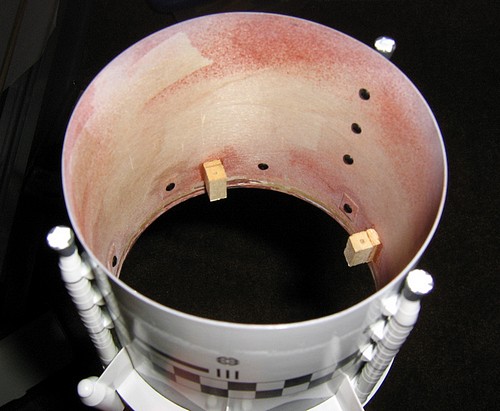
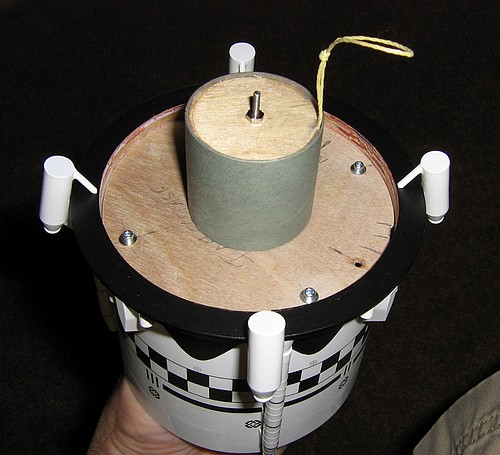
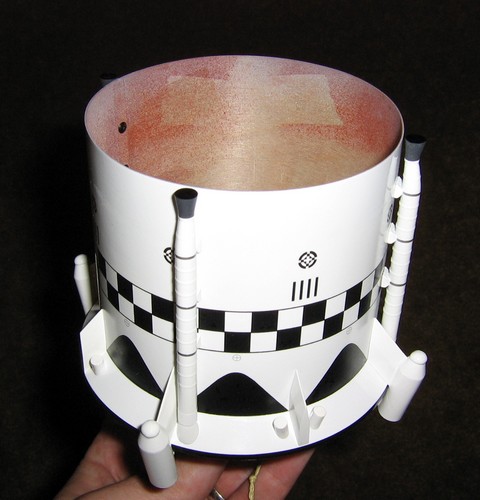
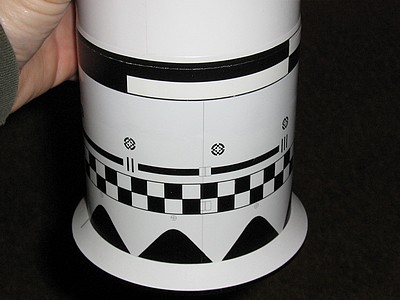
The Interstage is constructed of a single layer of 1/64″ plywood, a balsa/ply centering ring, and a styrene conical shroud. All details are painted resin castings with Monokote strips for added realism on the hydrogen vent lines. The roll pattern was printed on an ALPS printer and applied in two sections to the monokoted tube surface using the soapy water method. Several applications of Walthers Solvaset were required to get rid of all the wrinkles in the thin decal material.
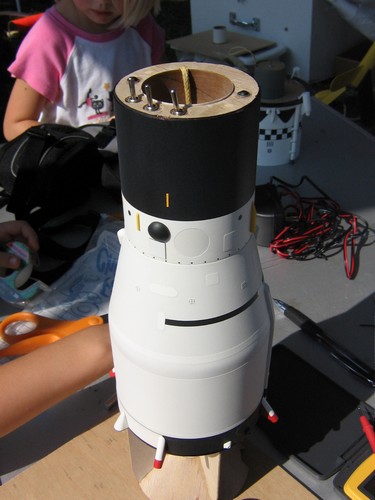
The photos below show the assembly inside and out. Note how shiny white Trim Monokote looks prior to applying the Testors Acryl Flat clear coat, as well as the extensive use of #2 screws for detail-mounting. The small round camera pods are the only details glued in place. The photos do not show the replaceable (sacrificial) coupler tube that protects the Interstage from upperstage exhaust.
S-IV Stage/Instrument Unit/Payload
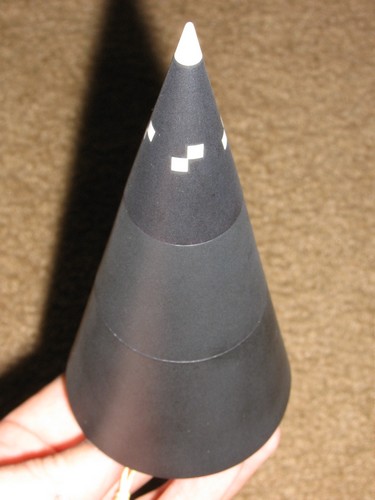
Jupiter Nose Cone
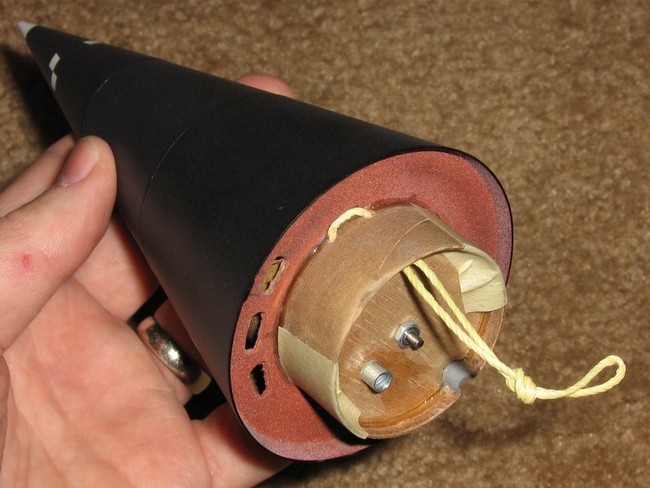
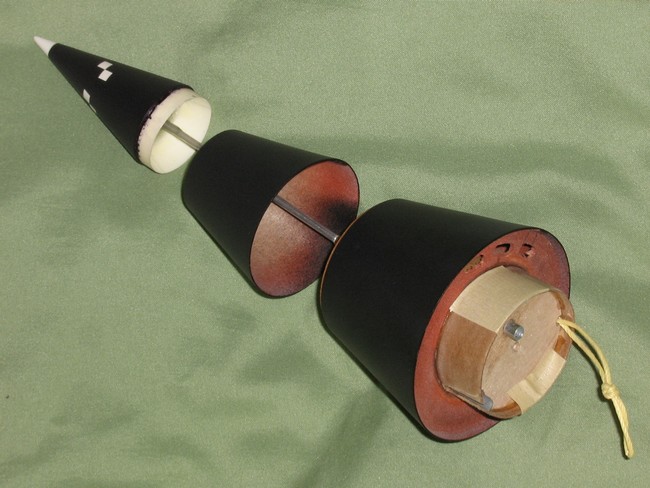
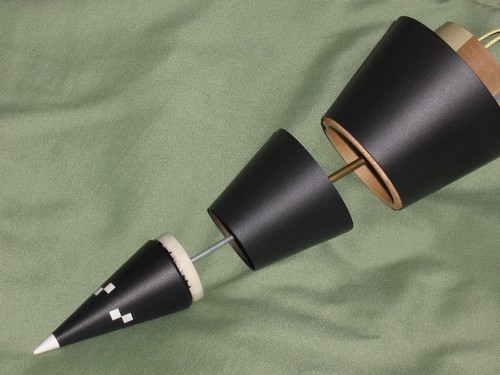
The three sections of the Saturn’s nose cone are held together by a center-mounted threaded rod and a nut. The top section is a roto-casted resin piece that contains an ounce of lead nose weight plus epoxy. The lower two sections are made from 1/64″ plywood rolled into a cone. Note the three oval holes in the bottom centering ring that accommodate the protruding RC-arming switches. There is also a separate T-nut (off-center) that allows the nose cone to be bolted to the side of the transport box. You can also see the gray plastic channel that fits over the 2nd stage’s shock cord.

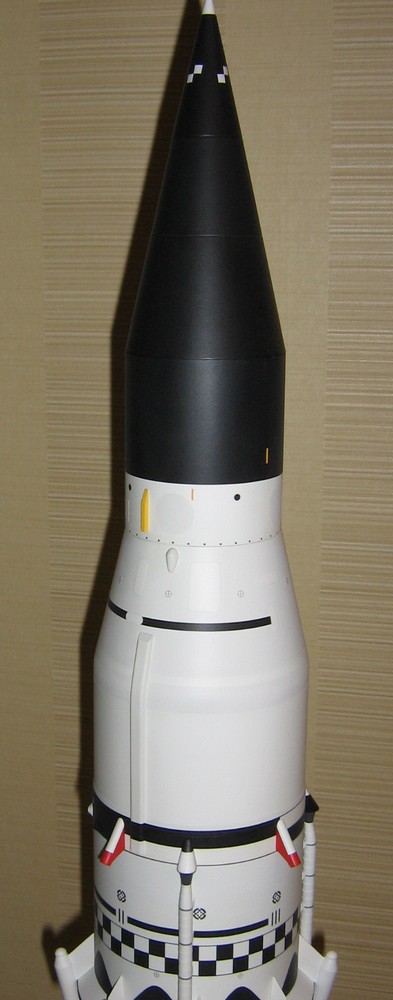
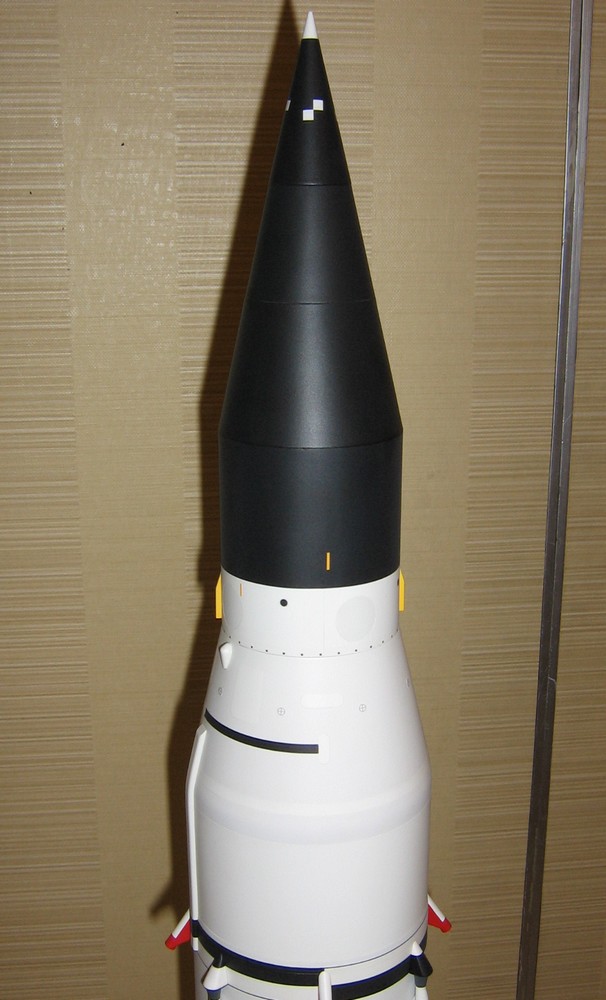
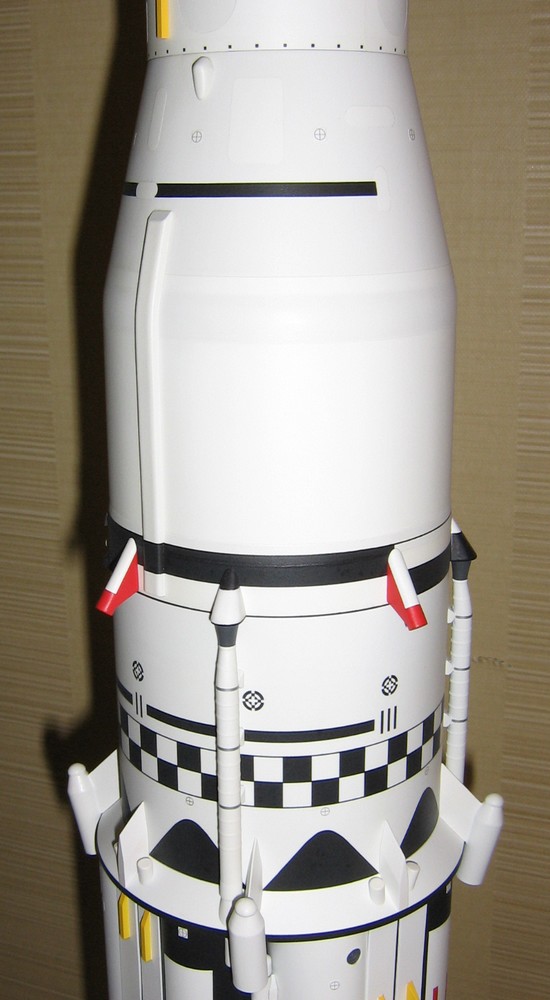
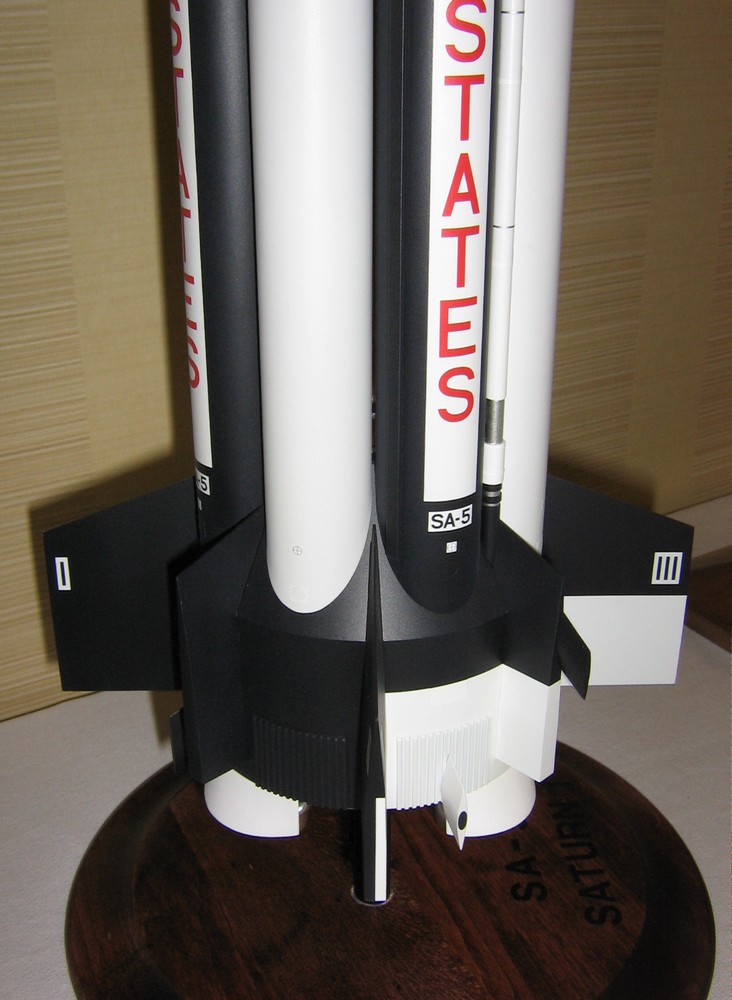
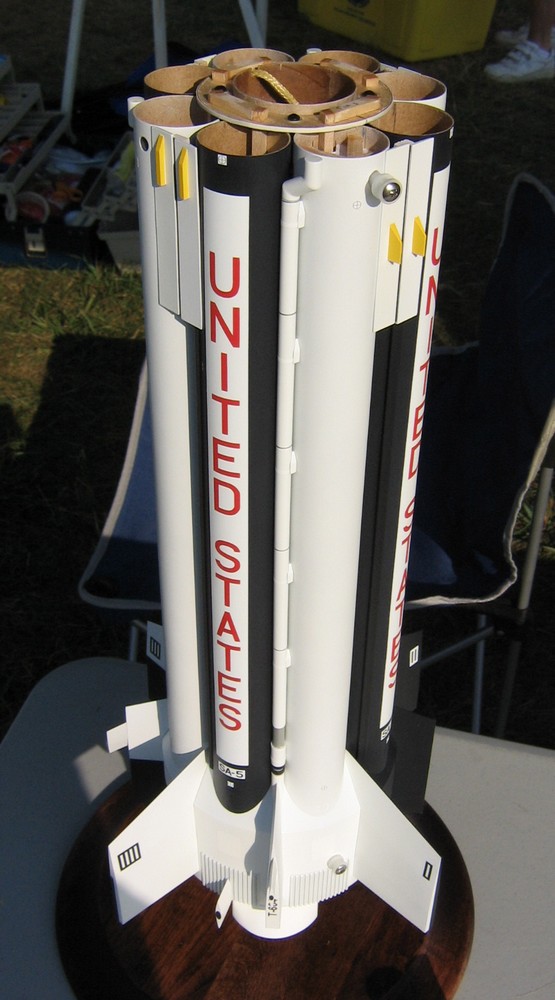
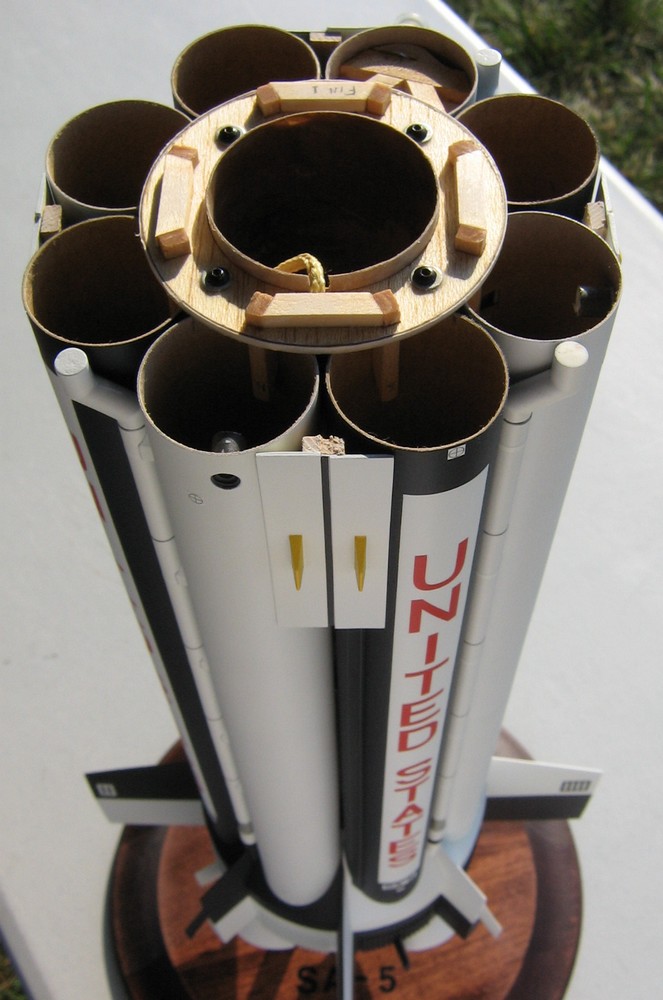
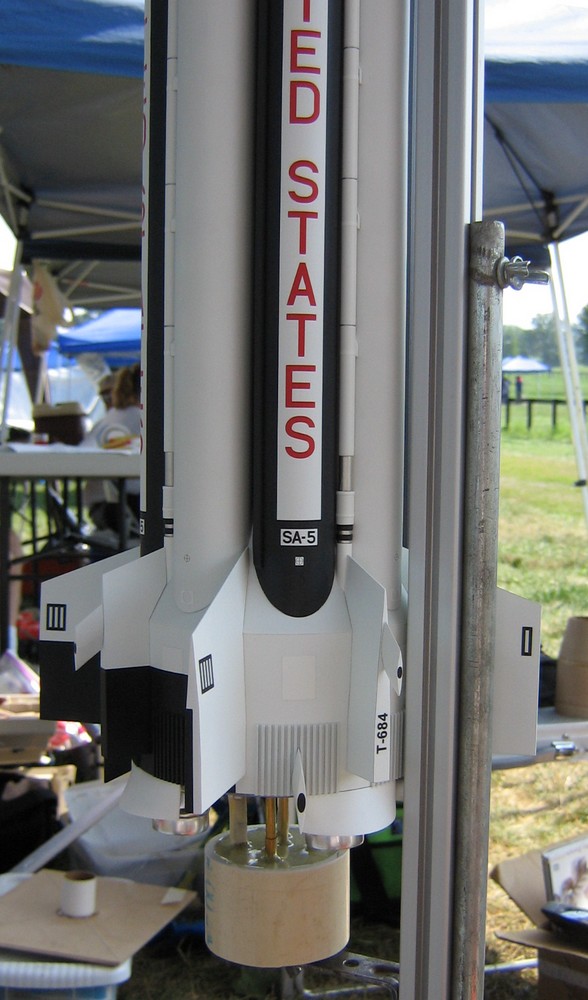
Photos of Completed SA-5 Model
Various close-ups of SA-5 Saturn I taken by Josh at NARAM-50





Details that I wanted to include–but couldn’t due to lack of time or some other good excuse…
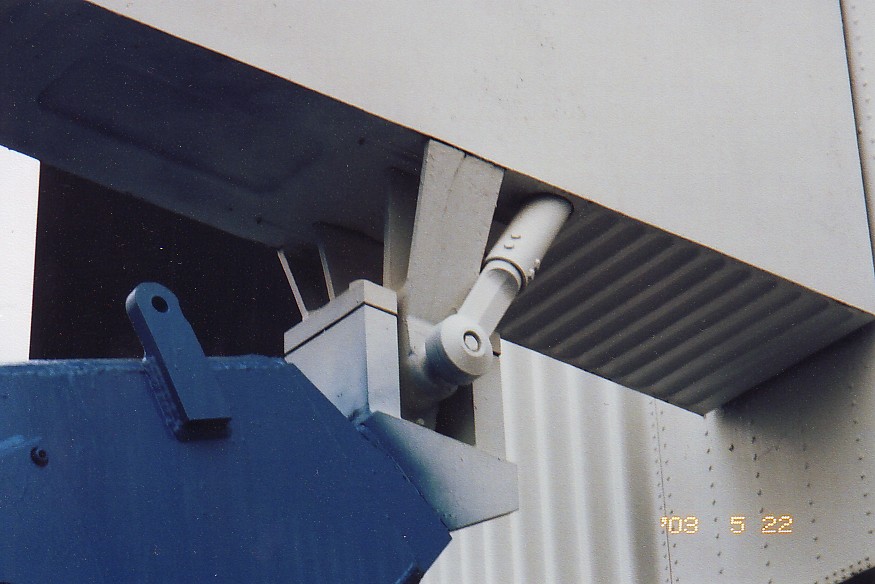
- Holddown Structures (under all eight fins)… These structures are fairly obvious (yet tiny even at 1:59 scale), so I was quite disappointed to not be able to add these to the fins. However, I do have some ideas how I might more easily incorporate them into future fin designs.
- Spherical Recessed hatch covers on Instrument Unit… As of November 2008, I already have developed a solution for this one!
- Fuel Tank Vents… I included the LOX vents at the top of the white tubes (obvious in photos), but I didn’t get to make the LH2 vents on the black tanks (located just beyond the upper right corner of the white stripe on each black tank).
- Propellant Dispersion Charges on all 8 tanks… In photos you can see a red cable-like object running most of the length of the tanks and positioned to the left side of the white stripe on the black tanks, and similarly positioned on the white tanks.
- Fuel and LOX drain connection (two total)… These were low priority, and I did not have any good photo data for them this time around.
- Inboard Engine Nozzles… I’m working on a possible solution, but it will take some R&D.
- Air Scoops on the engine skirts… Don’t get me started.
- Rivets and welds on the tanks and tail section… Ditto.
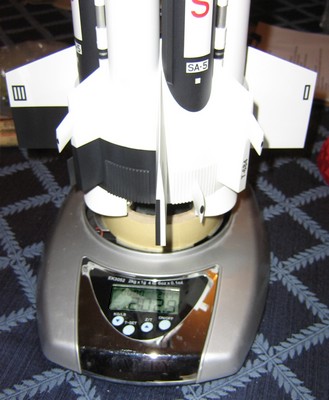
Adjusting the Saturn’s CG and Final Launch Weight

Recovery System for the Saturn I
- Nose Cone: 15″
- 2nd Stage: 30″
- Interstage: 12″
- 1st Stage: 40″
Both the booster and upperstage shock cords were anchored outside of their parachute compartments. This required notching the Interstage’s coupler tube as well as the shoulder of the 2nd stage nose cone to accommodate the thickness of a kevlar line running down the side of each chute compartment.
Saturn Launch Rail System
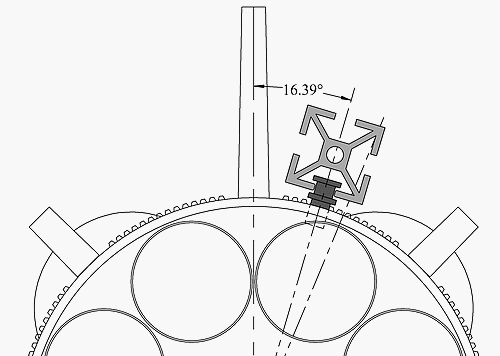
Continue to Page 5… NARAM-50 Flight